Showing posts with label macbeth. Show all posts

movies: the tragedy of macbeth

the tragedy of macbeth

The Tragedy of Macbeth is the 11th film version of Shakespeare's Scottish play that I've watched and the 23rd version of the play I've seen overall.

It might also be the first version that I've seen where I declared part way through the movie that I wanted to make out with the costume designer. Then later the cinematographer. And later still the production designer. Mary Zophres, Bruno Delbonnel and Stefan Dechant respectively, for the record. Also, the entire team responsible for digital set extensions and just the CGI team generally.

Because this movie is SO FUCKING BEAUTIFUL.

It's stylised to within an inch of it's life, and it's shot in black and white... and actually shot that way, not desaturated later... so the costumes rely on texture and pattern and material instead of colour. Same with the sets and the lighting. It's all about geometry and lines and shadow.

Total artifice and wonderfully sparse, but beautifully done.

But you could very literally take almost any still from the movie, frame it and put it on the wall and it would be the most wonderful monochromatic art piece.

Okay, so... what did Joel Coen choose to do with with my favourite Shakespeare play to make it his own?

Interestingly, he beefed up the roll of Ross (Alex Hassell)... he turned Ross into more of a priest than just another nobleman and Hassell's performance rides the line where you never know whose side he's supposed to be on and he always seems... a little creepy and a little Machiavellian. And, spoilers for a more than 400 year old play, as well as the movie... the inference here is that Ross is the one who saves Fleance and pushes Lady Macbeth down the stairs at the end rather than her leaping from a tower. He's much more of a "string puller" in this version.

Which is a take I haven't seen before.

He also chose Kathryn Hunter as The Witches. You might not recognise the name, but she was in the start of the fifth Boy Wizard movies very briefly, but she has a distinctive face and I recognised her immediately. Turns out that she's well known as a member of the Royal Shakespeare Company and is a respected theatre director and actor.

She's also mesmerising as The Witches. Or, technically, I guess, The Witch. Because while there are often three bodies on screen, either they are all Hunter and composited together or they are Hunter plus two other people of similar height and build. Hunter does speak in different tonal registers to indicate the three personalities of the Witches... but I'll be honest, in some ways, I wished they'd leaned into it more... actually had Hunter play three different characters who are mostly identical but maybe wearing slightly different outfits.

Because, honestly, more Hunter would not have been a bad thing.

It's interesting that Coen both included a number of actors from the Boy Wizard movies, but also cast a number of American actors in minor roles. And all of the black actors in the movie are American. Which makes sense, given that your Macbeth is both black and American... so it makes sense that they're all "from the same place" in the world of the movie.

Oh, and I just need to say that the Hair and Makeup Department did Banquo kinda dirty, giving Bertie Carvel big, bushy, comedy eyebrows. It was a choice... I honestly don't think it was a great choice given the often intentionally harsh lighting... those things often look like big angry caterpillars attempting to leap off his face.

But, I hear you cry... what about Macbeth and Lady Macbeth?

First... let me say that in the production of Macbeth that lives, forever, in my head... Macbeth needs to be young. Mid twenties at the most. I feel like the combination of that amount of avarice makes more sense on a young man. And if Lady Macbeth is still of childbearing age, the revelation that Banquo will be the scion of a line of kings holds more bite to it, rather than Lady Macbeth being beyond the age where that's a possibility any more.

I also would love to lean into the idea of Duncan calling Macbeth "cousin" more literally, and have the king be early 30's at most and his sons in their teens.

But, this isn't the imaginary version I would put together... 

This version stars Denzel Washington as Macbeth and Frances McDormand as Lady Macbeth. So, while I personally think that the Macbeths should be younger than they're presented here, you have to balance this against the fact that it's Denzel and Frances. And, I mean, especially Frances, because she's fantastic always.

Which isn't to say that Denzel isn't good... I just haven't seen him in that many things.

He plays Macbeth wonderfully... and this is possibly the best version of "Macbeth loses his mind at the moment he stabs Duncan" that I've seen. Other versions have done great work with that idea, but nobody else has really got down into it like Denzel.

But... I'm going to say... as a couple who are supposed to be in love, Washington and McDormand didn't really give me much in the way of chemistry. As conniving, backstabbing pair of regicides (also, it's weird that the word for the act and the word for the person doing the thing is the same word, it feels like it shouldn't be), I 100% totally buy them. But as a couple of who love each other and will do this horrific thing because of how much they love each other, not so much.

Which isn't blatant in the text or anything, I just feel that if you have that, it does a lot of the heavy lifting for their decision making.

But, like I said, they're both fantastic in their roles. And I was legitimately sad when we hit the point in the play where Lady Macbeth shows up less... because that meant less McDormand.

There were also moments of gold in very, very small roles.

Jacob McCarthy as Wheyface, the unfortunate servant that comes to tell Macbeth that the wood is on the move only has two brief scenes, and he's doing a lot of floppy hair acting, but he was memorable... as was Ethan Hutchison as MacDuff's son, who got a much more dramatic death than he usually does... and was actually really good in his one scene.

At the end of the day though, while this movie has many, many strong performances, a fantastically talented actress as the Witch, and charismatic actors in the lead roles... the strength of this movie is in it's visuals and it's design.

Absolutely stunning.

yani's rating: 5 geometric patterns out of 5 

fringe: macbeth in space! (and two other locations...)

adelaide fringe: macbeth in space! (and two other locations....)
As I've said on multiple occasions, Macbeth and I go way back. We have a connection. I can't explain it, not entirely sure I want to.

But it's one of the first shows I look for at the Fringe. And I've seen a variety of versions at this point.

Full text versions, classical productions, modern political retellings, Australian gangsters, World War 2... the works.

What I've never seen is Macbeth played as a comedy. And it absolutely should not work. At all.

But somehow, some way, the Scrambled Prince Theatre Company (a touring youth theatre company based at Eltham High School in Melbourne), managed to do it.

And so we have the very literally titled: Macbeth in space! (and two other locations...).

This is Macbeth as a Star Trek episode, Macbeth as film noir story, Macbeth as a western.

It's also at it's heart an ensemble piece, where different actors play the required characters during the different locations. Space Macbeth is a pompous Zapp Brannigan/Kirk hybrid, Noir Macbeth is a slightly stupid New York mafia boss and Western Macbeth is a very trigger happy black clad bandito.

And this is, somehow strangely, the only interpretation of Macbeth I can really think of where the play is going out of it's way to tell you that Macbeth is a bad guy. I mean I know he does horrible things, but often times there is more than a little part of me what wants him not to fall all the way down the rabbit hole of the latter part of the play, and remain the Macbeth from the first two acts.

But here, he's no hero, not even an anti-hero... in all three parts of this production, he's straight up the villain (and often also a thundering moron) in each setting.

Most of the story gets told across the three segments, although a lot of the details are left by the wayside... which normally I would find problematic, but I didn't mind here since this was more interpretation rather than recitation.

I also think that you can judge a lot about a Macbeth production not just by it's titular lord and lady, but by the interpretation of the witches. And here we get, in order, a hive mind, a trio of beat poets and three poncho wearing singers. With the exception of the hive mind, the same three actors play the witches (technically I guess the same three take part in all the versions, since the hive mind uses the voices of everybody who isn't a main character at that point), and do so very well.

I do need to specifically call out the young woman who played both Space Banquo at the start, as well as the western version of Young Siward (I'm blanking on the character's in-universe name)... she was great as the Kif to Space Macbeth's Brannigan, but she was AH-MAH-ZING as Kid Siward... right from the opening of that section with her tiny cowboy hat, tiny guns and repeated ridiculous expressions she had me in stitches.

In fact the list of people who impressed me or at least made me laugh is fairly extensive. From Space Duncan to Space Lady Macbeth... Noir Gumshoe (again, the character name escapes me) to Noir Fleance to Noir Lady Macbeth... Western Malcolm to Western Lady MacDuff... in fact almost everyone who stepped up into a speaking role did remarkably well.

And the whole thing was actually funny. I think, beyond the performances, it was tying all of the tropes from the three different scenarios to Macbeth that managed to bring out the humour.

Staging was minimal, confined to a few black stools, but each genre change came with a complete, on-stage costume change for the entire cast (all twenty-something of them)... and often the ensemble actually became the staging.

The other thing that shouldn't have worked was putting music in... but there it was, and work it did. The singer, who also doubles as Noir Lady Macbeth, did a fantastic job both with the singing and the acting... although given the aforementioned laughter at Western Siward, I did feel a little guilty that all my attention was focus over there and not on her beautiful rendition of Desperado.

My hat goes off to every one involved in this production, they did a great job and I had an amazing time.

yani's rating: 5 bouncy chairs out of 5

state theatre company's macbeth

Imagine, if you will, a combination of The Scottish Play, a suspense/horror video game set in an insane asylum and a post apocalyptic world at war.

That's probably the best jumping off point to start talking about the State Theatre Company's production of Macbeth. As always, my history with Macbeth is long and varied, but I will say that every time I watch a new version I'm always collecting details to add to the one that I would make (if that ever just randomly happened). And this production, directed by Geordie Brookman, had a number of those details.

Starting with the set design by Victoria Lamb and the lighting design by Geoff Cobham, you feel the weight of the play right from the moment you step into the theatre. As I mentioned before, the set feels very, very much like a run down, broken space, and the first thought I had was of an old insane asylum, but then the moment when the table first appeared absolutely wowed me and made me look at everything with fresh eyes. And there were other unexpected moments like that throughout the play that surprised and amazed me.

Likewise the lighting was amazing throughout. From the barely lit pre-play moments though to the very end, the lighting added another level to the characters and the setting, particularly the varied uses of the high up windows within the set. And because a lot of the lighting was very, very bright, the moments when the stage was plunged into darkness were totally black which is always what you want from a play like this. I think my favourite lighting moment was when Macbeth speaks with the assassins, just the way he's lit partially in green versus them under downlights, gorgeous.

Lamb also designed the costumes, which really went for the post apocalyptic/warrior vibe, not flashy, but perfect for the characters and the world they enhabit. A particular standout was the witch, partially due to the choice to dress her in colours that were much closer to those of the set than anybody else so at various points she disappears slightly, but also the decision to mask off her eyes. That definitely contributed to the suspense/horror vibe, as did the decision to have her drool, spit or pour blood on other characters throughout the play.

Speaking of which, this is by far the bloodiest version of the play I've ever seen. By the end the majority of the cast is slathered with varying degrees of gore, and the play even starts on a scene of blood, leaning into the idea (as I've seen in a number of other productions) that Lady Macbeth was pregnant and lost a child, in this case seemingly to miscarriage.

If I have any complaint from the production standpoint, it's relatively minor and concerns the music. DJ Trip has put together a unique electronic score for the production, but, at least at the beginning, I found the music slightly drowned out a couple of the performers. As the show progressed they either addressed that if it was an unintentional technical issue or I grew accustomed to it, because I'll admit that by the end I barely noticed the music on a conscious level.

As the titular Lord and Lady, Nathan O'Keefe and Anna Steen are incredibly strong. O'Keefe has moments of genuine madness towards the end that can sometimes be lacking and is at other times truly frightening. Steen has some brilliant moments, not least of all the traditional "out damn spot" scene, which was heightened in this production by using the witch and the fact of Lady Macbeth's eventual suicide and combining all three elements together, which is both acted beautifully, but also a brilliant choice for the story. I will say that their chemistry as a couple wasn't perhaps as strong as it could have been. There were moments, but in this production I really thought of them as two independent characters rather than as a malevolent duo most of the time.

While I've mentioned her a couple of times already, Rachel Burke as the singular witch was phenomenal. She never leaves the stage and will often drift behind the characters, moving incredibly slowly, only to lurk or drool blood on a murdered character or otherwise interact with them in an otherworldly fashion. Add to that the fact that she also fills in as both Fleance and Macduff Jr and masterfully transforms her personality for both of the characters, while still keeping her witchly appearance.

Her turn as junior Macduff also lead to one of many, many brilliant small directorial details that were littered throughout the play. As she is both the witch and Macduff Jr, when Macbeth appears and stabs the child, it is Lady Macduff who receives the wound, even though she hasn't been touched.

I also totally appreciated that as the play progresses the people that Macbeth has murdered appear as parts of a dead chorus, and in the final pre-battle madness they fill in as guards and stewards and the doctor, leaving you never completely sure whether or not Macbeth is just talking to the voices in his head or to actual people or to projections by the witch.

Another stand-out for me was Elena Carapetis in a very small role as Lady Macduff (as well as being part of the dead chorus and one of the murderers), and while I'm incredibly glad that they gave her that role because she's excellent, I really, really wished we'd seen more of her throughout.

All in all this is definitely a very strong outing for The Scottish Play with some incredibly strong directorial choices and beautiful performances thoughout.

Current Mood:

fringe: signifying nothing

adelaide fringe: signifying nothing
Signifying Nothing is Shakespeare done the way it's meant to be done... but with a twist.

Writer, co-director and star Greg Fleet takes the idea of the cut and thrust of the modern Australian political landscape and overlays it on the tale of deceit and ambition that is Shakespeare's Macbeth. Lord and Lady Macbeth become Paul and Lainey Macbeth... and the kingdom of Scotland becomes the premiership of Perth.

All of the action takes place in and around the bedroom of the Macbeths which makes perfect sense the more I think about it.

Half of the language is the bard's original, the other is Fleet's very modern Australian vernacular and parlance... not to mention a hell of a lot of profanity. Sometimes a word or two of modern language will creep into the Shakespeare to have it make sense in the world of the story.

And, you know what, it works... it works to perfection. It really shouldn't... but it does.

Fleet manages to capture the intent of Shakespeare's dialogue and then reinterpret it to fit his modern day context, weaving the two styles together so well that it never seems odd to go from Macbeth talking about taking Fleance to the football to Lainey reciting Lady Macbeth's first monologue direct from the play.

My ongoing love and familiarity with the Scottish play is, at this point, well know... and I will say that this is one of the best versions I've seen. It's a big call, but it's one I think is is well deserved.

A big part of that is Nicola Bartlett as the Lady to Fleet's Lord. She performs her lines the way that I want to see it done in every Shakespeare play that I see, with emotion and thought and feeling. They're not just a procession of words to be gotten out in the right order... no, Lainey Macbeth exists as a three dimensional character who is clearly thinking, feeling, plotting, scheming and manipulating with all the light and shade that that implies while speaking both Shakespeare's words and Fleet's.

Fleet's Macbeth is likewise fully formed, but he doesn't seem to have quite so much of the heavy lifting as far as the bard's prose is concerned. He also manages to make his Macbeth very charismatic.

Macbeth's friend and fellow politician Banquo (Luke Hewitt) and the five witches, as well as some initial set up and a recurring interview between Macbeth and a reporter (Roz Hammond) all take place projected onto the screen behind the bed (within the fiction of the play's universe, I think it's all happening on phone, tablet or television screens). It's an interesting technique and allows for additional parts of the narrative without additional actors on the ground.

To me this works the best in the initial conversation with Banquo and in the interactions with the witches. This is also ties into the use of technology in the rest of the play, specifically the "killing" of Duncan politically with a scandal rather than actually stabbing him.

As this version is only an hour long, and switches between modern language and the original text, all while focusing exclusively on the titular couple... so naturally there was a lot of the original play that had to go to make way for the new content. While it makes sense, I was sad to see sections like the entire banquet sequence be lost. It also felt like there were lines from parts of the play that I don't generally see performed.

Fleet's music choices also felt particularly spot on throughout the play, especially in the sequence where he mimes to a song (The Nosebleed Section by Hilltop Hoods, I think). It could have felt weird and out of place, but worked incredibly well.

If I had any complaints at all it would be that occasionally the prerecorded audio was a little hard to discern all the words to... particularly with the witches.

All in all I could not have asked for a better show to close out my Fringe 2017 experience.

Current Mood:

fringe: shakespeare's ménage a trois

adelaide fringe: shakespeare's ménage a trois
Four players, three plays... well, three sequences from three plays...two comedies and a tragedy.

I started this year's Fringe with a visit to the Raw Shakespeare Project, and here I am, nearly at the end with a return visit. And a very different experience overall.

For Shakespeare's Ménage a Trois, they've taken sequences from three of the Bard's plays, Much Ado About Nothing, Macbeth and A Midsummer Night's Dream and present them as self contained vignettes... so they become Beatrice and Benedick, The Tragedy of Lady Macbeth and Bottom’s Dream respectively.

As characters, Beatrice and Benedick are essentially screwball comedy before there was screwball comedy... and with Leah Anderson and Mark Drury as the titular pair, the barbs do fly thick and fast. Anderson clearly relishes the dialogue here and Drury is both leading man and prat-falling fool all at the same time.

Backing them up as four different characters are Isabella Shaw and Damien White... both Shaw and White have a talent for hamming it up (in the best possible way... and doubly so when White throws on a frock for comedy effect, especially with his beard), and in all three plays I found that I was drawn to Shaw anytime she was on stage, especially as Wall in Bottom's Dream (more on that in a minute).

After a brief break and a costume change Beatrice and Benedick transition to Lord and Lady Macbeth.

I will say that Drury makes an excellect Macbeth, but I did feel that Anderson was a little stiff in her delivery, more so in her opening monologue than when she spoke to Drury. But as I've said before, it's hard to remember all that dialogue AND be able to make it all live as speech at the same time. Or maybe that was just an acting choice for Lady M, as she was certainly full of personality in the other two sequences.

The sequence was very much Lady M's story (as the name suggests), so it kept some of my favourite lines ("O, full of scorpions is my mind, dear wife!") and lost others ("That which hath made them drunk hath made me bold!"). White and Shaw were less prevalent here, just because the story has been trimmed of all but a few additional characters.

And then, as Shaw announced to the crowd, Lady Macbeth needed a bit of a cuddle, so after a brief break we were back in the land of the fairies with Oberon and Titania.

The first thing I have to say about this sequence is that I absolutely adored the choice of costuming. I half wished they'd done this throughout, although how well it would have worked for Macbeth is debatable...

Drury as Oberon, Shaw as Titania and Anderson as Puck were all wearing jeans and printed t-shirts declaring them "Fairy King", "Fairy Queen" and "Hobgoblin" respectively. Drury's shirt especially got a massive laugh from the crowd (although all I could think was "I want one!"). White filled out the quartet as the ass-eared object of Titania's enchanted affections, and then the other three threw on coats and hats to play the players within the play.

Shaw did a fantastic job as Titania, managing to be equal parts sultry and petulant... and Anderson was manically gleeful as Puck, bounding across the stage at every opportunity and really showing a completely different side to her personality.

But where they all really shone were as the players... White was pompous and hammy as Bottom/Pyramus, Drury radically transformed into a very childlike Flute/Thisbe, Anderson combined the roles of Quince and Snug into one, also managing a very meek lion but the standout was Shaw as Snout/Wall... she was hilarious, rolling her eyes at Bottom and making Wall more than a little naughty.

I've never really like the player characters in Midsummer, they've always felt like Shakespeare came up a few pages short and was just padding the play out, but I genuinely enjoyed this interpretation.

In fact I thoroughly enjoyed the whole performance.

Current Mood:

fringe: the bunker trilogy

adelaide fringe: the bunker trilogy
Last time Jethro Compton and the crew brought The Bunker Trilogy to Adelaide for the Fringe, we were supposed to see all three parts on the same night. Unfortunately that didn't happen and we saw Morgana and Agememnon together and then Macbeth a couple of weeks later.

This time around I managed to see all three parts on the same day, one after the other. A lot of what I said last time definitely holds true this time around, and while I'll try to limit the amount of comparisons I make between the two versions, they are somewhat inevitable.

The titular bunker has been placed inside Noel Lothian Hall in the Botanical Gardens, and unlike last time, the audience never sees the bunker from the outside, entering through one of the doors to the hall and being transported straight into the dirt, wood, sandbags and inherent claustrophobia of the enclosed First World War themed space. The action for all three plays takes place within the space, with the audience seated around the outside of the room and the actors filling the space in the middle.

Actors Hayden Wood, Sam Donnelly and Bebe Sanders all return, joined this time by Jonathan Mathews.

As with the previous version, one of the things that was still so amazing to me given seeing the three parts back to back to back in the same space with the same actors is the way all four actors switch characters so completely from one play to the next. Possibly Sanders is the least changed, but even she changes accent and personality in each role.

It also appears that Compton and writer Jamie Wilkes made a few changes to the scripts (at the very least just to Macbeth, or at least that's the change that I noticed).

I will say before I jump onto the individual plays that, minor differences aside, it all holds up just as well this time as it did last time. The acting, staging and the experience that is The Bunker Trilogy is one that's well worth seeing.

adelaide fringe: the bunker trilogy - morgana
The Bunker Trilogy - Morgana

Morgana is a take on the Arthurian legend, with Wood as a suitably kingly and dignified Arthur, Donnelly as a rakish if slightly bullying Lancelot, Mathews as the naive and loquacious Gawain and Sanders as a sweet Guinevere. It's also a story of three young men who have known each other since they were children and who are now in the middle of a war the likes of which Europe hadn't seen for a hundred years. And Wilkes finds all the places that those two stories intersect, but I do feel that this is more about the World War I story than the legend. Which isn't a criticism, I think it's works exceptionally well that way.

In a lot of ways it's the lightest in tone of the three, starting with audio of Christmas carols being piped into the bunker (which to me doesn't work as well as having the characters being in the space singing like they were in the previous version), although it does darken in tone towards the end.

As I said about the previous version, Sanders has less to do in this play than in the other two, but that's mostly because this really is the story of the relationship between Wood, Donnelly and Mathews, in a lot of ways the characters that Sanders plays are merely accessories to that relationship. And you believe the relationship right from the word go, the three men have an easy chemistry that makes their interactions, both good and bad, completely believable.

adelaide fringe: the bunker trilogy - agamemnon
The Bunker Trilogy - Agamemnon

For Agamemnon, both Mathews and Sanders command all attention... Mathews as the titular Agamemnon and Sanders as his unnamed wife, Clytemnestra. In fact one of the most interesting things that I noticed about this play is that nobody is referred to by name (I guess due to it being too strange to have English characters called Agamemnon and Clytemnestra to be honest), and I don't think I noticed it the first time.

While this is very much Mathews and Sanders' times to shine, both Donnelly and Wood do excellent work here as well, Wood as meek and bumbling Aegisthus and Donnelly as an unnamed (but Scottish) battlefield soldier who takes care of the wounded Agamemnon. As I mentioned earlier, all of their transformations between this play and Morgana are the most extreme I think, especially Wood and Donnelly.

To me though, it's Mathews who really dominates this whole piece, flicking between the clear agony of a fatally wounded Agamemnon on the battlefield to the man that wooed Clytemnestra in the flashbacks which make up the other half of the play. Likewise Sanders does her best work here, especially in the latter part of the play where she comes to hate her absent husband.

The moving between past and present, which is a technique used in all three plays, is best used here I think, or at least due to both the lighting design and the use of the space, they're the most clearly defined sections between "then" and "now". Once again, the beginning of the play has been changed, without the characters already being in place when it starts, which I think is a loss to both this and Morgana.

It's the ending that puzzles me most of all though... I'm still not sure which of the two endings is actually the true one... or if they both somehow are.

adelaide fringe: the bunker trilogy - macbeth
The Bunker Trilogy - Macbeth

My obsession with Macbeth is well documented, and I still believe that the way that Compton and Wilkes have streamlined Shakespeare's original story down to the pure elements of the relationship of Lord and Lady Macbeth and Banquo is one that the Bard himself would have heartily approved.

Unlike the other two plays, this one features the original Shakespeare prose as opposed to more naturalistic speech, but the way it's been pared down is incredibly elegant.

This is also the only one of the three plays to keep the opening from the previous version where the three male actors are in the space as the audience enters, wearing gas marks and just being the creepiest thing ever without them having to do a great deal.

The masks are used well through the whole show in fact, both to signify the minor characters (and to not confuse the audience when an actor is playing three or four different roles), but most powerfully to signify the other-worldly characters... both the witches and the spirit of Banquo... as these shambling, twisted, zombie-like creatures. Removing the faces of the witches and making them almost empty vessels filled by evil spirits works incredibly well... and using the gas masks, which themselves signify a menace that itself can't be seen but can be felt (poison gas) is incredibly smart.


I feel like of the three, Macbeth is the one that has perhaps had the most changes, the best of which is the ending, which I mentioned last time as coming a little too soon and cutting out the battle between Macbeth and Macduff completely. Now there's an actual resolution instead of the instant cut to black, and it's definitely a change for the better.

Donnelly is brilliant again as Macbeth, there's something about him in general that is both magnetic and commanding, part of which he brings to Lancelot, but which he completely hides as the unnamed soldier... but as Macbeth he's as crazed and bloodthirsty as you'd want your Thane of Cawdor to be.

I feel like I've been somewhat harsh on Sanders overall, and while she does good work as the Lady to Donnelly's Lord, she just seems a little less passionate than her fellow actors... it's a shame, she does so well in Agamemnon, and I would have thought the fire she had there would have translated well to Lady Macbeth, but it just felt a little flat in spots.

Wood once again gives a strong performance as Banquo, and as I said last time, that friendly, open quality he brought to Arthur and Aegisthus makes him an ideal Banquo (there's also something about the relative height difference between Donnelly and Wood that manages to say a lot about Macbeth's ambition without it ever needing to be said aloud).

And Mathews is relatively absent from a major role this time around... he does play a lot of the incidental characters as well as Macduff right at the end, but seeing the plays in this particular order it seems like he'd be happy to take a slightly back seat after putting everything into Agamemnon.

All in all though, it's a fantastic adaptation of the Scottish play.

Current Mood:

movies: macbeth

macbeth - all hail
My connection (ie obsession) with versions of the Scottish play is well established at this point, so it's no surprise I was excited to see the version of Macbeth directed by South Australian director, Justin Kurzel.

And it's a stunning adaptation. Possibly the most beautiful I've seen.

Visually the combination of the Scottish locations (which I believe is the first time that there has been a movie version filmed on the Scottish moors), the cinematography from Adam Arkapaw, the production design, costumes and make-up all come together brilliantly.

Kurzel went with a very "realistic" approach, from the setting to the costumes to the set designs, it all feels historically appropriate. But settings like the final battle sequence are so spectacularly staged that they're just breathtaking.

Michael Fassbender plays the titular Thane of Glamis while Marion Cotillard is his lady... and they both do incredible work, even though I'm generally not a massive fan of Cotillard.

All the cast is great in fact, although I will say that the decision to use "authentic" Scottish brogue on top of the Shakespearean language did mean that even I who knows the play pretty much backwards and sideways couldn't always tell what they were saying.

There are generally three places where you make your mark as a director/writer with Macbeth... how you deal with the witches, the parts of the play you leave out, and the things you add visually because you can't add them verbally.

And this version got them all pretty spot on for the universe of the movie... the witches, beyond a little ritual scarification here and there, are very grounded in reality, as was everything else... although the decision to have essentially five characters instead of the regular three was a little odd, although one was a child and the other a baby. They also added in the ghost of a teenaged soldier who dies at the beginning, and assigned some of the lines from the witches to him, but that's easy enough to suggest that they conjure him.

I could complain a little about the parts they left out... but at this point I've seen versions with every possible combination of extractions... it's just that in this case, it's one of my favourite lines (and one that I have on the wall in my bedroom):
That which hath made them drunk hath made me bold.
What hath quenched them hath given me fire.
In fact a large amount of the things they removed from Macbeth/Lady M come from around the murder scene. Also gone is the "hubble bubble" sequence,I'm guessing because it felt too theatrical and over the top.

Other things to find themselves on the chopping block, as usual, were Duncan's younger son, the sequence between Malcolm and MacDuff about how terrible a king Malcolm would be, and the Lady MacDuff/Ross scene.

Those I can all live with them removing as they do have a tenancy to slow things down.

It's the things they added that were the most interesting... they add the battle that we only hear about at the beginning of the play, but then "show not tell" works much better in the movies. They also add in the "previous death of a child" that I've seen in a few versions which comes from one of Lady Macbeth's lines about knowing what it is to have a child suckle at her breast.

And the other thing is a sequence at the end that involves Banquo's son Fleance... given the fact that the witches tell Macbeth he will be king, but that Banquo will be father to a line of kings... but at the end of the play it's Malcolm who takes back the throne, not young Fleance, there's a cryptic little coda that may mean that Malcolm is going to now hunt down Fleance to secure his title.

It's definitely an interesting take, and not something that I've ever seen put together like that, and it was really, really good.

They also do a brilliant version of Birnam Wood "coming to" Dunsinane, and likewise not once I've seen depicted before.

This is a stunning version of the story, beautifully realised, brilliantly acted and a credit to everybody who was involved.

yani's rating: 5 ghostly daggers out of 5

fringe: the bunker trilogy - macbeth

adelaide fringe: the bunker trilogy - macbeth
Tonight we returned to The Bunker for the final of the three plays in The Bunker Trilogy, Macbeth.

And while it's easy enough to say that they saved the best for last, I think in this particular case it's very true.

It wasn't quite as emotive as Morgana or Agememnon as they used the original Shakespearean text whereas the others used more natural language, but it's easily the most powerful of the three.

Being greeted by three silent standing figures in gas masks is enough to give anyone the creeps and the masks are used brilliantly throughout the show for both the Witches as well as various other sundry characters.

Director Jethro Compton and writer Jamie Wilkes have pared down the text from the play and focused in, for the most part, on the Macbeths, Banquo and the Witches.

And using only Shakespeare's words, even if they're thrown out of their usual order in a few spots, the story of Macbeth's rise to power, the betrayal of his friend and the collapse of his relationship with his wife is actually all you really need from the play.

Sam Donnelly is brilliant as Macbeth... there is something commanding about his presence, in all three plays, so his casting makes perfect sense. As does Hayden Wood's... that friendly, open quality he brought to Arthur and Aegisthus makes him an ideal Banquo (and there's something about the relative height difference between the two that manages to say a lot about Macbeth's ambition without it ever needing to be said aloud). And Bebe Sanders seems to fully understand the ruthlessness that it takes to be Lady Macbeth. Sadly James Marlow doesn't feature very much beyond a creepily limb-twisted turn as a Witch and an appearance as MacDuff in the final moments of the play... but it's somewhat understandable to anyone who has seen all three plays, since he throws himself into Agememnon with such passion that there can't be much left in the tank at that point in the evening.

But, as I said, it's mostly a relationship between the three characters.

There were a few great touches in this particular version... the first was using the audience, who are encased inside the titular bunker with the players, as first apparitions during the initial scene with the witches, and then later as the dinner guests during the banquet scene. It's a great way to utilise what you have when you don't have a giant cast to fill in as the crowd.

I also really liked the way they handle the demise of Lady Macbeth... to be honest I'm still not sure if it was real or imaginary, but it gives a hell of a different spin on her famous "out damn spot" scene, and one that I particularly like.

And as I mentioned, the use of gas masks for the Witches is creepily perfect... it makes them completely anonymous characters, makes them essentially faceless and changes the actors voices all in one fell swoop. I'm also not sure if it was intentional, but there's one point where a character is under a very bright light in a gas mask and the glass in the eyes was sending shafts of light onto walls and audience members with the aid of a little smoke machine magic.

There were also certain lines that both Donelly and Sanders put particular life into... it's easy enough with Shakespeare to merely recite the words, but it's quite another thing to be able to give them the raw emotion they need or to invent new moments of emotion on otherwise familiar lines and they both manage that very well.

I was also intrigued that given the way that the other two parts of the trilogy ended that the climactic battle scene between Macbeth and MacDuff is absent... it does feel a tiny bit abrupt, and given that the beheading of Macbeth is generally the point where the audience gets to feel relieved that justice has been served on the titular villain, a little odd.

All in all though, it's a great interpretation of The Scottish Play and a worthy finale to The Bunker Trilogy.

Current Mood:

manchester international festival's macbeth

macbeth - national theatre live
Seeing the Manchester International Festival’s production of Macbeth presented by National Theatre Live in the Palace Nova movie theatre was something of a unique and slightly odd experience.

The performances took place in a deconsecrated Manchester church in July this year and were filmed by National Theatre Live, so it's something of a hybrid between a movie and a live theatre performance.

I can imagine actually being in the audience at the church would have been an incredible experience, the performance takes place in the the nave or middle aisle of the church, while the audience is seating along the two aisles to either side.

Also adding to the unique set up for the play was the fact that the nave was also covered in a layer of earth, which made for a very different aesthetic and performance space and added a layer of pseudo realism to the fact that wading through dirt would have been a common occurrence at the time the play was both written and set. This was compounded by the fact that they somehow managed to make it rain inside the church during the opening battle scenes, turning the earth to mud.

I did feel a little like it was getting in the way at some points... I was more aware of the fact that the actors were having to slog through this layer of mud than I would have liked, and it meant that certain moments lacked a little bit of elegance as it's hard to walk across an uneven muddy surface.

Otherwise the church was an absolutely gorgeous setting, especially the alter area which is dressed with a large number of candles.

I'm going to be honest, although Kenneth Branagh has done a lot of Shakespeare in his time, I wasn't overly captivated with his portrayal of the titular Scottish thane. In fact the whole thing felt a little... melodramatic, if I'm being completely honest. Not just from Branagh, but from all the actors. I know it's Shakespeare and one of the tragedies and as such has a heightened sense of emotion and drama, but it felt a little bit much. Especially when it meant that a lot of the performances seemed to be permanently pitched at about 11.

I think I was also expecting some of the River Song style strength from Alex Kingston's portrayal of Lady M, but again her performance seemed to be coming from a more melodramatic place, especially the "out, damned spot! out, I say!" seemed a little over the top given some of the more haunted versions I've seen of that scene.

I really, really wanted to like this... but I have to say that I've seen better versions.

I was also a little disappointed with the three witches... generally you can tell a lot about a production by how they treat the witches, but they went with a version where they screeched a lot of their lines and although they turned up on stage at a few points that weren't specifically witch scenes, I didn't think their makeup and costuming choices were completely memorable. Yes, they looked unnatural in dark grey shift dresses and matching facepaint, but I just wasn't feeling it.

There were a few unique touches... most notably casting Banquo as a much older man (Jimmy Yuill) which then meant that Fleance (Patrick Neil Doyle), his son was a young man in his twenties rather than a child... but also their interpretation of Birnam Wood as shields constructed of thin branches.

So all in all, while it was an interesting experience, it wasn't the best one that I've had with Macbeth.

Current Mood:

urban myth theatre company's macbeth

urban myth theatre company - macbeth
I took my annual trip (at least for the last four years) to see a production of Macbeth tonight.

This version of the Scottish play featured the Senior Ensemble of the Urban Myth Theatre Company, many of whom, according to the program, were working on Shakespeare for the very first time.

It's also possibly the first version of Macbeth that I've seen where the titular character was actually the third most charismatic male actor.

But in a lot of ways, once I managed to get my head around the idea, it actually served the character and the play better than I thought it would.

Edwin Kemp-Attrill's Macbeth is craven, small and at times a little bit awkward.

Some versions of Macbeth that I've seen, the main character has a long way to fall from the moment we meet him until the final battle scene, but Kemp-Attrill's version embodies a different kind of Macbeth.

By comparison both Nic Cutts who performs double duty as both King Duncan and the heroic Macduff and Josh Mensch in his role as Banquo both light up the stage with personality and charisma.

During Mensch's first appearance I couldn't help making the comparison between him and Kemp-Attrill and wondering whether he wouldn't have made a better Macbeth... but as soon as Cutts appeared, I felt like he was actually the Macbeth I was waiting for.

But, having said that, by the end of the play I would not have traded in either Mensch or Cutts performances.

Mensch does a brilliant job as Banquo... and once the character becomes the gory-locked spirit Mensch ramps his performance up to about eleven. He also manages to completely transform himself for the small role as Lady Macbeth's doctor, not just through costume, but his performance feels completely different.

Cutts is hard to take your eyes off of every time he steps on stage. There were two scenes that really stood out to me... the first being when Lady Macbeth (Alex Petkova) welcomes Duncan to the castle... Cutts scoops up Petkova like she's his long lost little sister, and it makes everything that comes after feel that much more like a betrayal.

The second moment is MacDuff's speech once he learns that Macbeth has slaughter his entire household. I've seen that scene performed about a dozen times, but this is the first time I've witnessed such a raw, emotional performance like the one Cutts gave. It's not over the top, it's clearly a man who is totally in shock and trying to process the fact that his whole world has just fallen apart. And it's the second time that I've teared up during a performance of Macbeth.

It also means that when the final confrontation between Macbeth and Macduff happens I was more emotionally invested than I have been in some performances.

Petkova was an interesting Lady Macbeth... her finest performance moment is during the "out damn spot" sleepwalking scene, especially when she walks towards the audience intoning "to bed" over and over. But there are other moments where she feels less convincing.

To be honest, a lot of the moments with Petkova and Kemp-Attrill conveying the passion between the two characters didn't completely ring true for me, although I'm not completely sure why. When Cutts embraced her it was believable, but when it was Lord and Lady Macbeth it just felt a little hollow.

Petkova also takes on the role of one of the witches along with Emma Kew and Lucca Boyce who managed to make the hair stand up on the back of my neck in their opening scene. It's something about when the witches speak in unison that always has the ability to do that to me.

Director Nick Garsden edited the play down to under two hours and took out a number of scenes or edited others sometimes a little severely. While I recognise the scenes that were lifted out completely, there was only one edit that really stood out to me, and that's during Macbeth's second confrontations with the witches and he describes seeing a vision of Banquo and his children... there was a slightly clumsy edit that removes all references to the children except for the final line. If you weren't familiar with the play you may not notice it, but it stood out to me.

Set and costume designer Kerry Reid chose an interesting look and feel for the play... it's one part industrial, one part Australian military and one part post-apocalypse. The set was completely comprised of corrugated iron columns with the occasional quote from the play graffiti'ed on the walls.

The costumes were mostly a lot of big greatcoats, waistcoats, black pants and a lot of hats in black, grey and dark blue... although there are brief moments of colour such as Macbeth's red waistcoat and Lady Macduff's blue gown.

While it wasn't the most polished of productions I've ever seen (even though this was the last night of a ten night run), there were a few moments that made it worth the trip to go and see.

Current Mood:

bell shakespeare's macbeth

bell shakespeare's macbethOne of the things I love about seeing so many versions of The Scottish Play is seeing where each company takes it.

And, I have to say that Bell Shakespeare's production of Macbeth is all about the ladies.

Kate Mulvany's portrayal of Lady Macbeth was amongst the strongest I've seen... all sharp edges, barely contained rage covering a raw grief and one of the most dreamlike and mentally fractured "out damned spot" scenes.

And, something I don't know that I've ever seen before in Lady M, a dash of humour when she took the "that which hath made them drunk hath made me bold" line at face value and drunkenly hiccuped her way through the scene. It sounds strange, but it actually makes perfect sense within the context of the scene.

The two areas that usually mark the most difference between various interpretations of Macbeth are in the treatment of the ghost of Banquo and the three witches.

This is the first production I've seen where the two things are intertwined.

Firstly there's the single witch, performed by Lizzie Schebesta... her "black and midnight hag" is beautiful, blonde, ethereal and fragile... which just serves to make her even more otherworldly. And added to that is the vocal processing they used on her voice, giving this feminine creature a demonic and androgynous aspect.

She was also marked with a thick black line down the centre of her face... which added to the oddness because it was also there when Schebesta appeared as Fleance, the unnamed Macduff child, the wife of one of the Lords at the banquet and all of the minor servant roles, particularly at the end of the play.

Whether it's because all of these characters have some impact on the prophecies given to Macbeth by the witch or if there's some other interpretation, I don't know... but it was an interesting take on it.

Also interesting was the interactions between the witch and Banquo's ghost... I mean it makes perfect sense... the witch is supernatural, as is the ghost... but the staging of the banquet scene with the witch/Lady drawing Banquo's ghost to her lap and rendering him invisible to Macbeth was beautifully done and slightly disturbing.

But it wouldn't be Macbeth without the titular performance by Dan Spielman.

He delves the depths of the character's madness and ruthlessness, but there was something... weasely... about his performance that made him somehow less likeable. Yes, I know, a play about someone who murders his ways through king and countrymen and women and little children and I'm worried about his likeability...

But before his decent into blood and insanity... I don't know if likeable is exactly the right word, but there was something that I didn't connect with.

Although the decision to replace the minor role of the assassin of Lady Macduff and her household with Macbeth himself... which was a brilliant decision, firmly cementing the depths to which he'll sink to control his destiny.

The rest of the cast was much more ethnically diverse than I've experienced with Macbeth in the past... and I think the combination of that, the costuming and the set design made the whole thing feel particularly Australian.

The set design featured a tilted stage covered in "bushland"... grass and weeds and patches of empty ground, all of which was reflected in a Space Odyssey style shiny black monolith tilted in opposite direction to the ground.

The costume design also had something of a bush theme to it... the men especially felt like shearers or outlaws and Macbeth himself was channelling a particularly "Ned Kelly" vibe with the hairstyle and beard.

There was more of a 50's/60's vibe to the women's costumes... Lady Macduff being more of the former and Lady Macbeth having a slightly more vampy 60's feel to her look.

I'm not sure what was with the light blue military jackets for the men though... it did contrast nicely with the oranges of Lady Macbeth, and it was very visible on stage.... but it seemed almost out of place amongst the darker, more naturalistic colour palette.

Both the interpretation and the staging of the play also felt quite fresh. Other than the staging I've already mentioned regarding Schebesta's witch, they also took the moments in the play that either deal with internal monologue or private conversation and had all the actors not actively involved in the scene move in "slow motion", which was distracting at first, but became more and more cinematic as it went along.

Director, Peter Evans, and Mulvany, in her role as Dramaturg, have chosen to include more of the original text than I've seen in most other versions, but at the same time completely remove a number of the minor characters (or have them be played by the witch). The most notable example of this is the complete removal of Lady Macbeth's maid and the doctor during her "spot" scene.

A bold choice, but as I mentioned before about this scene, one that works brilliantly.

All in all, this was both one of the more original versions I've ever seen as well as being amongst the best.

And totally worth the trip to Sydney.

Current Mood:

uatg's macbeth

macbeth by university of adelaide's theatre guildLast night I went to see another version of Macbeth by the University of Adelaide Theatre Guild... this makes at least seven versions (possibly eight, I'm sure we watched a movie version of it in school when we were reading the play, but I couldn't tell you what version it was).

Even the weather was contributing to the overall feel of the show, with wild weather and rain which could occasionally be heard on the roof during the quieter moments in the play.

Given that it was at the University of Adelaide, I think I expected that the cast itself would all be university students (which would at least be something different, a young adult version), and this theory was kind of supported by the fact that the crowd was quite young and there was at least one if not two high school groups there (I'm guessing English or Drama).

But the cast was actually not that different from what you would expect in any production of Shakespeare.

The set design was also fairly average, in fact it reminded me of the set for the Jeremy Sims version of the play I saw a number of years ago... quite dark, multiple levels but this one used a number of symbols relating back to the play... a stylised tree that grew up the entire left side of the double height set, the right hand side was given over to a design suggesting large stone blocks. And right in the middle of the "balcony" space was a large image of the actor playing Macbeth. That I could probably have done without to be honest.

But the double height/multiple level set was actually a really good use of space within a fairly small theatre. Whether it could have been used to greater effect during some of the sequences, I don't know (it would have been nice to see the witches up there), but overall I think the staging worked well.

And because nobody ever seems to want to sit in the front row right off the bat, I got a front row (more or less centre) seat no trouble at all... I always like that in plays, lets you feel like you're right in the middle of it all.

Speaking of the witches, having seen a lot of variations on the witches, from school girls to a constant presence on stage to disembodied voices in the dark to dance party participants the morning after, this was the first time I've ever seen blacklight used for the witches. In fact this is probably the first time I've ever seen blacklight used in Shakespeare.

And it was pretty damn effective, especially as the witches were wearing opaque plastic CSI style jumpsuits with white clothes underneath... combine that with essentially dark faces under the blacklight and the glowing suits... interesting.

Speaking of costumes, this was another "modernist" take on Shakespeare complete with cargo pants/SAS style gear for the battles and a white suit for the king. It actually reminded me of the VS Macbeth version last year, although with a slightly anachronistic mix of modern gear and some fairly gothic touches, most notably Lady Macbeth's propensity for velvet dresses.

As I've said, I'm pretty damn familiar with the dialogue of Macbeth, but as the play progressed there seemed to be dialogue I just didn't remember... whole sequences between familiar pieces of dialogue in fact. For example, I never remember hearing at the beginning of the play that they're actually at war with Norway before.

It turns out that this was actually an unabridged version of the play. They had a Q&A session at the end and while I didn't actually stay for it, I did manage to ask one of the crew guys... maybe the director, I don't know... about the extra text. As he said to me, Macbeth is Shakespeare's shortest play, so why abridge it in the first place (this version was 145 minutes not including a 20 minute intermission). While I didn't necessarily spot all the places where things had been restored, I think I more felt it from the general rhythm of the play.

And I may have actually known that it was unabridged if I'd remembered to take any money with me so I could buy a program... but annoyingly I didn't, so I'm not even sure who some of the actors were.

Which of course brings me around to the performances.

Unfortunately I think I now have an impossibly high yard stick for performances of Macbeth after the absolutely stellar version by Body in Space at this year's Fringe, so everything else is going to be judged against that version.

Having said that, there were some solid performances... I think the main stand out for me was Simon Davey as MacDuff... the emotion he puts into his performance after learning that Lady MacDuff and all the wee MacDuffs have been murdered is heart-wrenching.

But if I'm going to judge impact versus time on stage then the show is essentially stolen by Emily Branford in the role of the Porter. She has beautiful comic timing and commands the stage during the whole "knock knock knock" scene (Act 2, Scene 3). And even without any dialogue she stole the earlier scene where Macbeth arrives home.

I also thought that Karen Burns as both Donalbain and a young soldier in the final battle was excellent and made a strong impression, even though she has very few lines.

The titular Lord and Lady Macbeth (Brant Eustice and Amanda Shillabeer respectively) are both solid, although there's an odd combination or contrast between modern and "Shakespearean" cadence between the two of them which sounds strange but not in a bad way.

There is the occasional instance of "shouty" dialogue though, particularly when the emotions run away in the play, which works from an emotional point of view even if they are hard to hear.

There were also a few slightly spotty performances... one of the murderers, one of the "all purpose thane/soldier/cousin" types were a little underwhelming, but mostly the supporting cast was fairly good.

All in all though, a successful version of The Scottish Play.

Current Mood:

fringe: macbeth

macbethI've said it before and I'll say it again... I'm starting to have an obsession with versions of Macbeth...

It all started with studying it in high school... so I know the story, I know what's going on... but I've seen it six times now. I saw an amateur version years ago where the witches stayed on stage the whole time... a version with Jeremy Sims as Macbeth... last year we saw the very excellent VS Macbeth... I've seen the Macbeth movie set in Melbourne, and the Japanese reinterpretation, Throne of Blood...

But tonight's version, by New Zealand group, Body in Space, was quite possibly the most intense, moving and beautiful version of the lot!

It all starts with the location... and given that this was in one of the old gutted Regent Arcade cinemas, it had an incredible atmosphere (and we also managed to snag seats that were essentially front row centre... although possibly, seats to the right of stage would be preferable for certain scenes). And because of the location there was no backstage, no curtains, no wings... nowhere to hide... as we filed in, all of the actors were sitting around the stage, Macbeth in the centre, playing instruments and singing this beautiful but mournful song. And they stayed that way essentially... sitting around the stage in a half circle while waiting to perform, getting up to do their part, then returning to the seat and becoming a blank slate, ready to be filled by a new character.

I can only imagine that the way they performed the play is like travelling troupes of actors may have performed it in Shakespeare's day... they had no backdrops, no major costume changes, everything they use on stage is right there, either tucked away in the boxes they sit on (which double as chairs when needed) or just lay next to them, like swords and musical instruments. There also wasn't any amplification... it was all natural sound and echo from the location (which made it a little hard to hear certain lines... but honestly, it's Shakespeare, the lines aren't anywhere near as important as the emotion of the thing).

And there are only six of them. One woman and five men, all of whom, with the exception of Macbeth himself, play multiple roles (and occasionally furniture).

Even any necessary sound effects... horses or birdcalls or the sounds of "spirits"... are provided by the actors on stage. Very realistically in the case of the horses... and incredibly disturbingly in the case of the spirits.

In fact, the director's note in the program says that she chose to structure the play around the line "a poor player that struts and frets his hour upon the stage and then is heard no more"... and there is a moment towards the end that really reinforces that, but mostly it just felt like pure, unadulterated theatre.

It's also the only version of Macbeth that I've ever seen that made me cry. And that is squarely down to an amazing set of performers.

Both Douglas Brooks and Laura Irish are magnetic and emotionally raw as the titular Lord and Lady... I don't know that I've ever seen such incredible passion between the two characters, and it made sense to me that she could manipulate Macbeth to do such terrible things because he is so madly in love with her.

And that when she says "Come, you spirits that tend on mortal thoughts, unsex me here, and fill me from the crown to the toe top-full of direst cruelty!"... she's actually becoming a witch herself and bringing down spirits with her blood, something that I've not seen before in any of the versions, but which makes complete sense.

But Brooks broke my heart time and time again... his passion, his fury, his raw hacking sorrow. Irish too... there are moments, especially right before the interval, that just tore out my heart with how incredibly believable and real and raw she was.

Roger Sanders, Daniel Allen, Jeff Brooks (Douglas's brother perhaps?) and Luke Walton (Walton perhaps less so than the other, but only because he seems to have less parts to play) are equally good... although not as raw and effecting, they are incredibly mercurial, slipping from one role to another with ease and a completely realised character each time even before they speak!

From Sanders' going from regal king to uncouth porter to sexually ambiguous assassin, Allan's turn from crazed witch to gentlewoman (even with stubble) to the son of Macduff and Brooks' transformation from old man to young boy in a matter of moments.

I've seen versions where you become somewhat confused about who the limited cast are playing now... but in this, while I wasn't always sure who the character was right away, I always knew when there was a completely new character on the stage.

This truly was the BEST version of Macbeth I've seen so far! I'm incredibly disappointed that they're only doing three shows! They're in the midst of the second one as we speak and the third and final show is tomorrow at 7:30... I cannot recommend getting tickets highly enough!

Simply amazing!

Current Mood:

festival: vs macbeth

vs macbethToday was mostly taken up with going to see Vs Macbeth... Ma had her haircut this morning, so I went shopping on my own, then came back here and essentially waited around.

Once she got here we headed down to Norwood, grabbed a quick bite to eat and then went to The Odeon.

I will admit to being a little miffed by The Odeon staff... normally theatre staff take the stub at the end of a ticket and give you the rest of it back... that's the way it's been all the way through the Fringe, and even at the movies. But at The Odeon they took the whole ticket. Not happy.

Oddly enough the show was General Admission, so we were able to get a seat right in the front row, reasonably close to the centre.

As I've mentioned before, I have an odd connection with Macbeth... but this was something else entirely.

To quote from the program...
Vs Macbeth inverts what we would normally do in a rehearsal (to remove errors) and instead restages every accident from our own rehearsal, as well as some significant incidents from the play's 400-year history of performance.
The staging of the play is outstanding... we walked in to essentially a bare/industrial looking stage complete with black and yellow warning tape on the floor, an electric guitarist (David Heinrich) off to one side, pieces of staging off to one side and three female "ushers" in orange security vests directing people.

The three witches (Aliro Zavarace, Ursula Mills & Zindi Okenyo) were already on stage (I also love it when there's a male witch amongst the three... and these three looked like they'd come straight out of a dance party), performing something in the middle of the stage and it took me a while to work out that they weren't just doing random movements, they were repeating the same set of movements over and over and over again... which essentially felt like they were casting a spell, over the play, over the audience, over the actors. It was also a sequence that resonated again right at the end of the play and made all the hair on the back of my neck stand up.

And it turned out that the three ushers were actually actors... and right before the play started, they walked up and down the ends of the rows and started Chinese Whispers going through the audience. The front row managed three before the play started, but the last one ended with me after a giant crash of thunder.

The entire play has something of an industrial/modern/post apocalypse feel about it... the costume palate is totally muted, all grey and black... the "armour" is a cross between motorcycle gear and paintball/skirmish gear... and actually the swords of the play have been replaced with paintball guns.

The first time one of the "rehearsal errors" occurs it's a tiny bit disconcerting, they essentially break character, but after a while it all becomes part of the play.

They also essentially demolish the set as the play progresses, mostly due to incidents from the play's history.

On top of the fantastic staging, the acting is also outstanding...

I saw Cameron Goodall (Macbeth) once before and was impressed with him then... after today, you can ramp that up by a factor of about 10, he's exceptional. Essentially Macbeth starts the play in reasonable grip of his sanity and spends the rest of the time losing his mind... and Goodall portrays that brilliantly. Equally good is his Lady Macbeth, Amber McMahon... I'm usually fond of the Lady M character, she's strong and twisted and goes spectacularly nuts, and you could quite easily say that even more than the witches, she's the character that sets everything in motion. And Amber brings all of that... there's a scene right after the "Banqo Banquet" where the Macbeths are just sitting there and every emotion their characters are feeling are written over their faces.

While everyone performed fantastically, the other major standouts had to be the sadly underused Zindzi Okenyo when she switched from witch to Lady MacDuff... she was frankly heart wrenching. And keeping it in the family, Tahki Saul as MacDuff was equally powerful.

My only complaint is a very small one, and that's because I think they compressed some of the action to take place between different characters, so it was occasionally difficult to keep track of who was supposed to be who. But that wasn't enough to decrease my enjoyment of the play (and in fact it's often the case that you lose track of who's who in Shakespeare plays... or is that just me?).

The show opens in Sydney in a couple of weeks, and I strongly suggest either catching it here in Adelaide before it goes, or heading down to the Sydney Theatre Company and catching it there.

Afterwards we headed up the street to get some dinner, and happened to run into J... one of those "of all the people in all the world" moments really...

Current Mood:

movies: macbeth

macbeth - by the pricketh of my thumbs...I have this really odd connection with Macbeth...

It was one of the Shakespeare plays I studied in Year 11 English (and I think we watched some random film version of it too)... and I've been to see two different stage productions, a random community theatre thing that wasn't bad (although Macbeth did kind of look like he was armoured in a VW)... and a more lavish production at the Festival Theatre starring Jeremy Sims where I had a front row seat...

And I've read Terry Pratchett's Wyrd Sisters (which is incredibly loosely based on Macbeth) and seen the cartoon version...

Which means I know the material... moreso than any other Shakespeare play actually... granted, I couldn't recite chunks of it from memory, but I know how the story goes and who's doing what to whom...

And I'm also very fond of Melbourne...

So take Macbeth, set it in modern day Melbourne with gangsters... and you really can't do much wrong in my books...

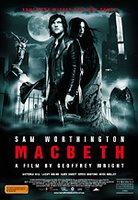
Which is exactly what happened with this Geoffrey Wright version... although with around 45 other movies titled Macbeth (according to IMDB.com), you do wonder if the world needs any more.

This version was good though... the tweaks and stretching of the original tale that they had to do to get it to work in the "ganglands of Melbourne" actually worked really well... mostly they just used the very simple trick of having random action without any dialogue for things they wanted to "interpret" that weren't in the original play. And I'm fairly sure they didn't cut that much out of the play... although they did cut one of the lines I remember really well, but it's a silly line, so I can see why they didn't go with it.

And this version of the three witches was quite good... they seemed more like a figment of Macbeth's imagination than real flesh and blood creatures. And slightly psychotic tattooed schoolgirl witches at that...

One thing that I'm not sure worked in the movie's favour or to it's detriment was the fact that I knew almost all of the male actors on sight... that's the problem with some Australian movies... a lot of times they don't go out looking for the new talent, the unknowns... they just use the tried and true actors that you've seen in a million, billion other things... in this case people like Steve Bastoni (who I kind of always associate with Police Rescue), Matt Doran (who was Mouse in The Matrix), Damian Walshe-Howling (from Blue Heelers), Rel Hunt (who showed up on not only Heartbreak High but also Blue Water High) and Gary Sweet, one of the "old men" of Australian teevee, who's seemingly been in everything at one time or another...

And then there were the three actors I automatically associate with being comedians (I don't necessarily think any of them are actually that funny... but comedy is what they do)... Bob Franklin, Mick Molloy and the seemingly uncredited Kym Gyngell...

Not to mention the couple of other actors that I either recognise the name of but can't place the face, or else know the face but can't remember their name (and the whole "no photo" thing on IMDB.com isn't helping either)... and then there's Lachy Hulme who is actually a very good friend of a couple of people I used to know... weird...

The really odd thing though was that while I recognised almost all of the male actors, there wasn't a single one of the female actors that I knew from a bar of soap. I don't know whether the host of recognisable female faces just weren't interested in the movie... or whether it was because the role of Lady Macbeth went to the movie's co-producer, Victoria Hill, the rest of them just didn't want roles... or what... but it just seemed odd to me.

I was also a little disappointed that for a movie that was set in Melbourne, it seemed very light on recognisable bits of the city after the first ten minutes or so. I guess there's not much you can do when the movie is pretty much set all in one castle (or, in this case, private house)... but I did enjoy the couple of bits of Melbourne that I did recognise.

Big snaps go to the costume designer, Jane Johnston, though... not only for Lady Macbeth's gorgeous dresses, but also for putting Macbeth in both a teal and gold suit (it sounds hideous, but was actually very hot) at one point and then a leather kilt for the finale. And also for dressing the sole blonde gangster (Rel Hunt) in white or light colours.

As far as the acting goes, I thought that some of the actors were a little spotty in their line readings... particularly Sam Worthington as Macbeth and the aforementioned Victoria Hill as Lady Macbeth... there were a couple of moments when Macbeth's lines seemed to be delivered too quickly and in too modern a speech pattern... I can't describe it really, it just felt wrong.

That's part of the problem with doing Shakespeare I guess... and especially with doing a modern version of it... not only do people have a wealth of previous performances to judge you against, they also have very strong ideas about how roles should be played and lines should be read.

All in all though, it was very enjoyable... not up to the standard of Baz Luhrmann's Romeo + Juliet, but still enjoyable.

yani's rating: 2 tattooed schoolgirl witches out of 5